EM Flow Creator
Automate SEM and TEM workflows across a wide range of applications.
- Batch samples through a standardised run without operator intervention
- Run unattended overnight or between shifts. The instrument keeps working when your team doesn't
- Extend access to users who aren't microscopy specialists; if the recipe is built they can run it
- Free users from repetitive setup, giving them more time for analysis, troubleshooting, and the work that actually needs them
Overview
EM Flow creator turns your microscopy workflows into a recipe anyone can run. It's flexible enough for routine imaging, yet powerful enough for the most demanding research applications.
How it works
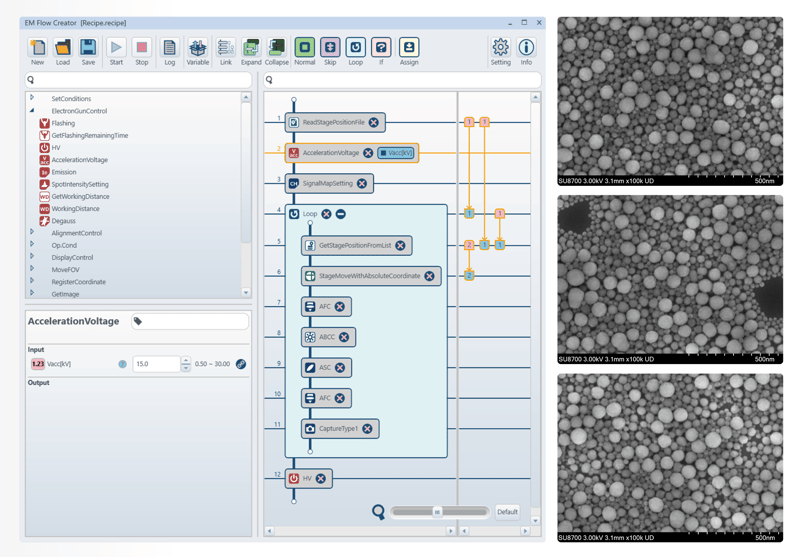
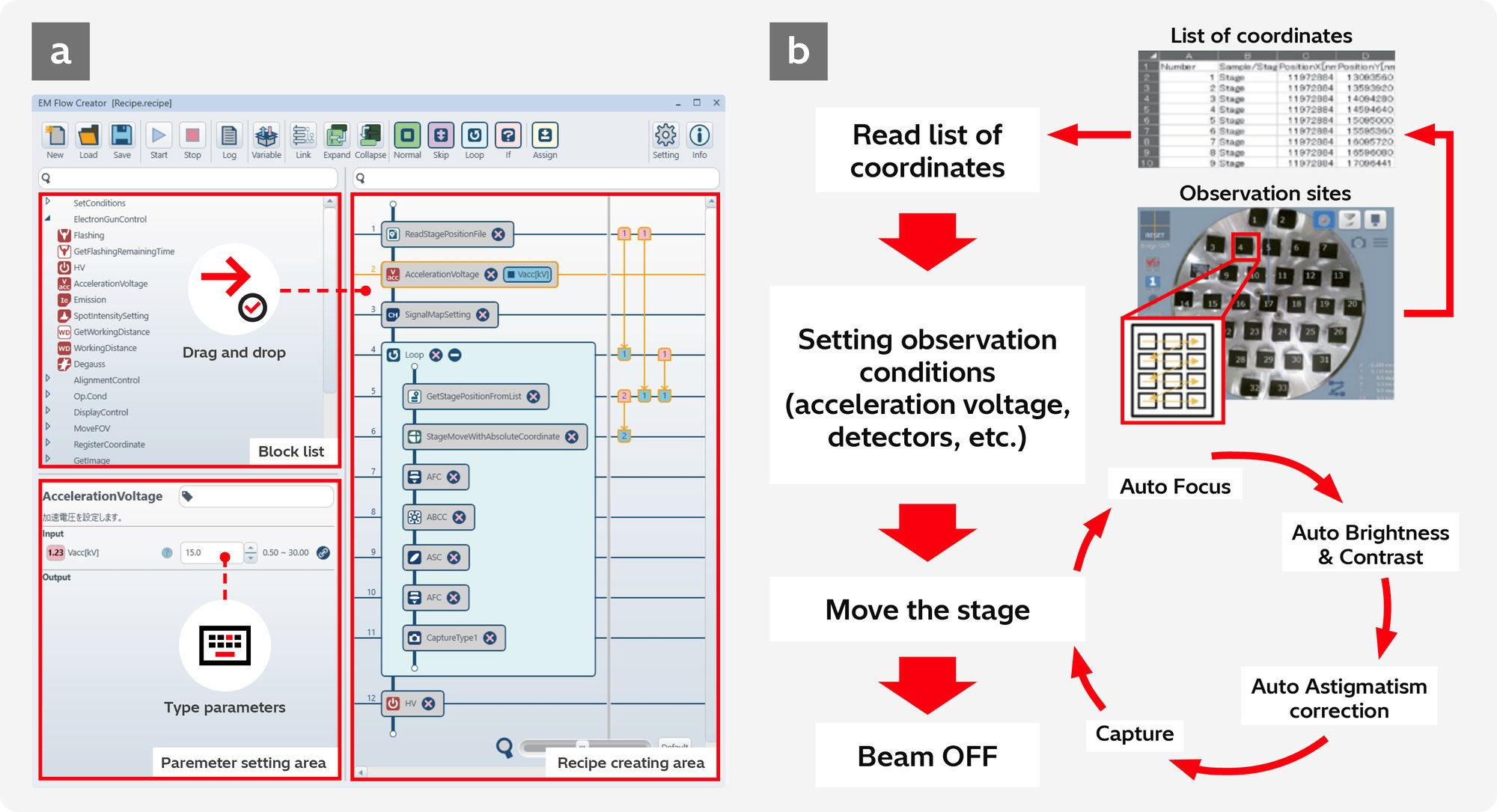
EM Flow Creator uses an intuitive drag-and-drop interface to help you create “recipes” by selecting procedural blocks from a comprehensive list. These blocks are sequenced in the recipe area, letting you automate complex procedures with no coding needed.
Key capabilities include:
- Sophisticated logic: The software supports sequential execution, looping, and conditional branching, allowing your microscope to respond dynamically to what it “sees”.
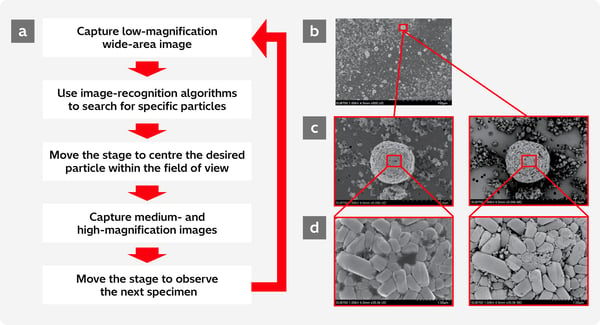
- Intelligent image recognition: Integrated algorithms enable the tool to search for specific features and automatically adjust the field of view to center on targets of interest.
- Broad compatibility: EM Flow Creator is now available for all Hitachi SEM and TEM platforms.
- Python options: While the visual interface handles most tasks, advanced users can execute custom Python scripts to extend functionality for highly specialized needs.
Typical observation workflow and its description in EM Flow Creator.
(a) Screenshot of EM Flow Creator session. (b) Outline of observation workflow.
Case Studies
-
Lithium-ion battery (LiB) analysis
In battery research, understanding the morphology of active materials and seperators is crucial for performance and safety.
Automated observation of positive-electrode material for lithium-ion battery.
(a) Outline of observation workflow.
(b) 500x secondary electron image.
(c) 5kx secondary/backscattered electron image.
(d) 35kx secondary/backscattered electron image.(Instrument: SU8700. Accelerating voltage: 1kV. Detectors: Upper and Middle detectors.)

-
Semiconductor device inspection
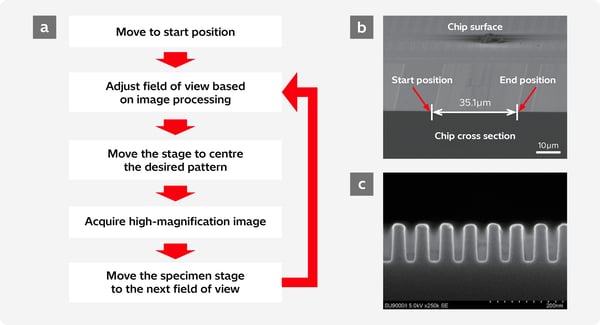
A common task in semiconductor material analysis is the sequential cross-sectional observation of device patterns.
Automated cross-sectional observation of semiconductor device patterns.
(a) Observation workflow.
(b) Secondary-electron image at 800x magnification.
(c) Secondary-electron image at 250,000x magnification.(Instrument: SU9000II. Accelerating voltage: 5 kV. Detector: Upper detector.)

-
Bio-sensing and life sciences
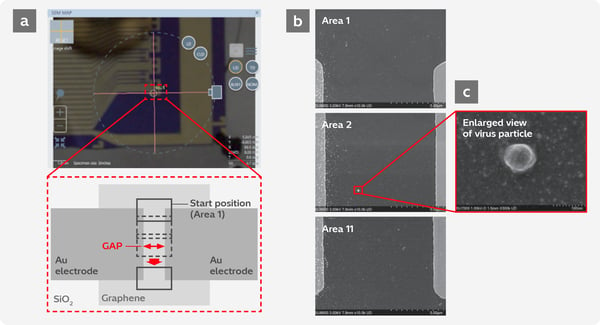
Automation is equally transformative in the life sciences, where finding minute biological structures across a large substrate is a common hurdle.
Automated observation of electrode-gap sensor for virus measurement.
(a) Optical microscope image and schematic diagram of electrode gap.
(b) Secondary-electron image at 10,000x magnification.
(c) Secondary-electron image at 300,000x magnification.(Instrument: SU8600. Accelerating voltage: 3kV. Detector: Upper detector.)

Live Webinar and Q&A
Wednesday 15 July 2026 | 11:00 CET