Talk to an expert
Ready to see the difference artifact-free preparation can make? Contact a Hitachi applications specialist to discuss your specific applications or book a IM4000II demo.
Contact Us
Hitachi High-Tech Europe
3 min read
You've invested in a high-resolution SEM. You've optimized your imaging parameters. But when you examine your cross-sections, you’ve got smeared interfaces, unclear grain boundaries, or scratches obscuring the fine details you need to see.
The problem isn't your microscope. It's your sample preparation.
As materials become more complex, traditional mechanical polishing increasingly falls short and often acts as a huge bottleneck in electron microscopy workflows.
For example, quality control teams in electronics manufacturing are dealing with multilayer circuit boards where copper and epoxy behave completely differently under a polishing wheel. And battery researchers need to examine porous separator films without crushing their delicate structure.
Mechanical grinding and polishing work well for simple, uniform materials. But they introduce their own set of problems like surface scratches and embedded abrasive particles. When you're analyzing a soft polymer coating on hard metal, mechanical methods either gouge the polymer or barely touch it, creating an uneven surface that makes accurate measurements impossible.
This is where broad ion beam (BIB) milling offers a different approach. Instead of physically rubbing or cutting your sample, it uses a beam of argon ions to gently sputter away surface material, atom by atom, without ever touching the sample. No mechanical force. No chemical reactions. Just a clean, flat surface (or cross-section) that faithfully represents what's actually inside your material.
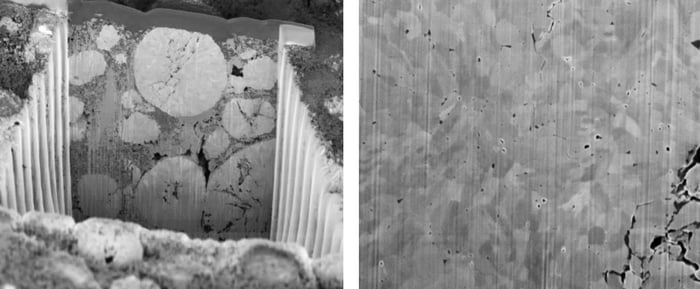 Example of FIB prepared cross-section, showing typical curtaining artefacts.
The fundamental advantage of BIB milling is simple: nothing touches your sample. Argon ions, chemically inert and non-reactive, strike the surface at controlled angles and energies, knocking away atoms through physical sputtering.
Because there's no grinding wheel, no abrasive slurry, and no blade cutting through your material, you avoid the damage mechanisms that plague traditional methods.
The difference shows up immediately in your results. Samples prepared by BIB milling produce sharper electron backscatter diffraction (EBSD) patterns because there's no deformed surface layer confusing the signal. Energy-dispersive X-ray spectroscopy (EDS) maps show true composition without contamination from embedded polishing debris. And when you examine interfaces between different materials, like a ceramic coating on metal, you see the actual boundary, not a shadowing artifact created by differential polishing rates.
BIB milling excels with heterogeneous materials that frustrate traditional methods.
Consider a lithium-ion battery electrode: it's a mixture of active particles, conductive carbon, and polymer binder with precise porosity. Cut it with a blade and you'll compress the structure. Polish it mechanically and you'll smear the soft binder while barely affecting the hard particles. BIB milling removes all components uniformly, revealing the true three-dimensional architecture that determines battery performance.
Or take a quality control engineer examining a solder joint between a chip and board who needs to see all the intermetallic layers clearly. Mechanical polishing might pluck out brittle phases or smear soft solder, obscuring defects. BIB milling cleanly exposes cross-sectional areas several millimeters wide, far larger than the tiny windows that focused ion beam (FIB) systems can prepare, and without the gallium contamination that FIB introduces.
Fiber-reinforced composites present similar challenges. Whether it's carbon fibers in aerospace parts or glass fibers in automotive components, you need to see both the fiber arrangement and the matrix properties.
BIB milling preserves the fiber-matrix interface without the fiber pull-out or resin smearing that mechanical sectioning causes. Researchers can then accurately measure fiber distribution, void content, and coating thickness, which are critical parameters for material qualification.
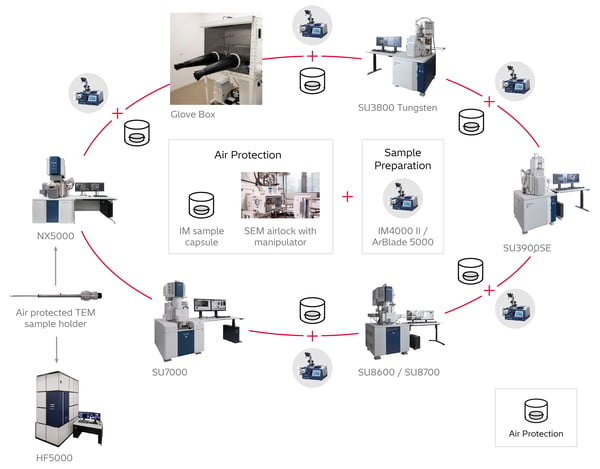
Beyond image quality, BIB milling changes how labs handle difficult samples. Metallography technicians know that some materials require hours of careful hand-polishing and results still vary by operator skill. With BIB milling, once you establish parameters for a material type, you get consistent results run after run. Load the sample, start the program, and return to a polished cross-section. Moreover, increase your lab efficiency with BIB: while BIB can do the time consuming mm-wide cuts alone, your FIB and its operators can concentrate on the cross sections with with nm lateral precision.
For failure analysis teams dealing with unknown or mixed materials, this consistency matters. You might receive anything from a fractured turbine blade to a delaminated paint chip. Rather than developing a custom mechanical polishing protocol for each unique sample and risking damage to evidence, BIB milling offers a universal approach that works across material types. Industries from automotive to aerospace to forensics benefit from this flexibility, particularly when time-sensitive decisions depend on accurate microstructural analysis.
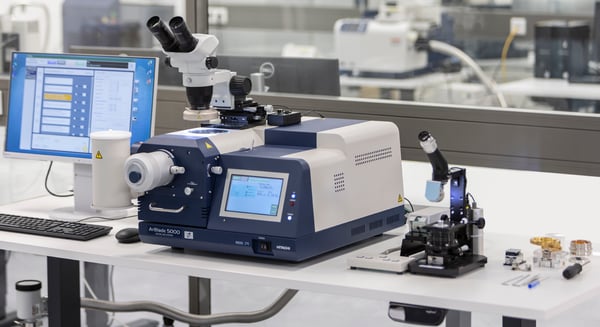
Sample preparation shouldn’t be the weak link in your SEM workflow. From mm- to nm-scale: Consider your most problematic samples, such as the multilayer coating where you can't tell if interface gaps are real or prep artifacts, or the porous material where you're unsure if you're seeing true structure or damage.
These are exactly where BIB milling delivers value. Systems like the Hitachi IM4000II offer the flexibility of both cross-section and flat milling, high milling rates for faster turnaround, and optional cryogenic cooling to protect temperature-sensitive materials, all while eliminating mechanical artifacts.
When your analysis drives important decisions about research, production, or failure investigation, it's time to evaluate whether contact-free preparation could solve your most challenging sample prep problems.