Skip to the main content.

Hitachi High-Tech Europe

Q&A: During a Webinar on Tabletop SEM-EDS Analysis

2 min read

Share this article:

Q&A: During a Webinar on Tabletop SEM-EDS Analysis

Slides and demonstrations can explain how a technique works. But the real priorities of users often appear during the discussion that follows.

At the end of a recent webinar on elemental analysis with tabletop SEM-EDS, participants raised a series of practical questions. They touched on topics such as sample preparation, detection limits, automation, and how easily EDS data can be analyzed outside the microscope.

These questions reflect something important. When laboratories evaluate compact SEM-EDS systems, they are rarely asking only about specifications. Instead, they want to understand how the system fits into everyday workflows — how quickly results can be obtained, how much preparation is required, and how flexible the analysis process can be.

Below are several of the most relevant questions that emerged during the session and what they reveal about practical SEM-EDS use.
1
Did you need special sample preparation to obtain these results, for example conductive coatings?

In most cases no special preparation was required. One example shown during the webinar was an oxide powder sample where charging effects were expected. However, thanks to the low-vacuum operation of the tabletop SEM, the sample could be analyzed directly without coating or additional preparation.


This highlights one of the practical advantages of tabletop SEM systems: many samples can be inserted and analyzed with minimal preparation, making them suitable for routine laboratory work.

2
How does the large beam current mode influence the lifetime of the tungsten filament?

The large current mode does not affect filament lifetime. It mainly adjusts the condenser settings and beam alignment rather than increasing stress on the filament itself. As a result, the operating lifetime of the tungsten filament remains essentially unchanged.

3
Is it possible to add EDS to older versions of the TM4000?

In many cases upgrades are possible, but compatibility depends on the specific system version. Hardware and software configuration need to be checked individually to determine what upgrades are feasible.

Users interested in upgrades are typically advised to contact the supplier with their system details.

4
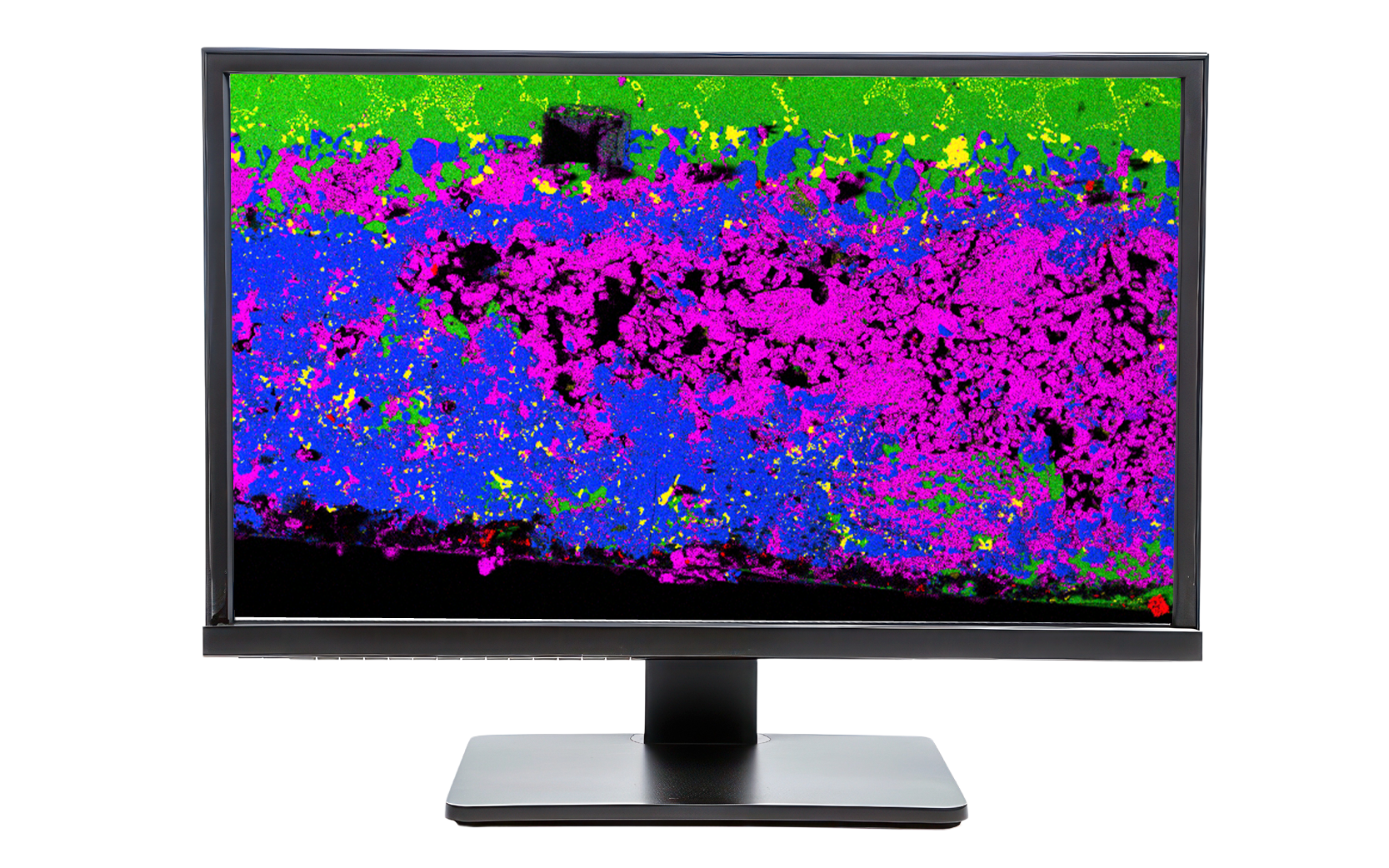
You showed an EDS map covering about 4 × 3 mm. Can larger areas be analyzed?

Yes. Larger areas can be mapped by automatically stitching multiple fields of view.


For example, automated mapping of hundreds of individual fields can produce elemental maps covering areas larger than 8 × 4 mm, allowing users to screen large samples and then zoom in on specific particles or features for detailed analysis.

5
Is it possible to create custom Python scripts with the automation system?

Yes. The EM Flow Creator interface generates Python scripts automatically from the graphical workflow editor.


Advanced users can modify or extend these scripts with additional Python code, allowing highly flexible automation routines and custom analysis workflows.

6
Is it possible to analyze the EDS data away from the microscope?

Yes. Data can be saved and processed offline on another computer.


This allows users to perform detailed analysis or reporting on a laptop while freeing the microscope for other users.

7
What detection limits can be achieved, particularly for light elements?

Typical detection limits for EDS are around 0.4–0.6 wt%, depending on several factors including:

  • accelerating voltage
  • atomic number of the element
  • measurement conditions

Light elements generally require slightly higher concentrations to be

8
What are the maximum sample dimensions and weight?

Typical limits for the TM4000 tabletop SEM are:

  • Maximum sample diameter: ~80 mm
  • Maximum sample weight: ~500 g

These dimensions allow analysis of a wide variety of samples including metals, powders, polymers, and mineral specimens.

Final Takeaway

What stood out in this discussion is not just what the system can do, but how it is used in practice.

The questions consistently focused on speed, simplicity, and flexibility, from minimizing sample preparation to handling data efficiently and scaling analysis when needed.

This reflects a broader shift in microscopy: users are looking for tools that integrate smoothly into their daily workflows, not just instruments with strong specifications.

Tabletop SEM-EDS solutions are increasingly meeting that expectation and bringing reliable elemental analysis closer to where decisions are made, whether in research, quality control, or production environments.

Watch the webinar on demand